Last updated: October 29, 2026
Quick Answer: For toddlers ages 1 to 3, the safest toy is usually a large, sturdy, age-labeled toy with no small removable parts, magnets, or button batteries.
Key Takeaways
- What is safe for a 1-year-old is often different from what works for a 3-year-old.
- Safe toddler toys for 1-year-olds are large, simple, and hard to swallow.
- Safe toddler toys for 2-year-olds can be more complex, but they still need to withstand rough play without shedding pieces.
- The age shift is about coordination and judgment, not a pass for small parts.
Toddler Toy Safety Guide by Age: What Is Safe for 1-, 2-, and 3-Year-Olds? matters because the right toy depends on the child’s age, mouth size, hand control, and play style. For 1-, 2-, and 3-year-olds, the safest rule is to pick larger toys, avoid small removable parts, check labels, and treat magnets, button batteries, and chipped paint as non-negotiable hazards. See the American Academy of Pediatrics toy safety guidance and the U.S. Consumer Product Safety Commission (CPSC) toy safety information.
The age-by-age rule for toddler toy safety

What is safe for a 1-year-old is usually not the same as what works for a 3-year-old. Age labels on toddler toys are a starting point, not a guarantee, because they usually reflect choking risk, fit, and intended play style rather than your individual child’s habits.
The American Academy of Pediatrics points parents toward simple, sturdy toys with no small parts for younger toddlers, and the U.S. Consumer Product Safety Commission (CPSC) uses age grading and hazard warnings to keep toys out of hands where they do not belong. The label matters, but so does the design. A wooden toy with a loose plug can be riskier than a plastic toy with a tight, one-piece body. A toy marked for 2+ may still be wrong for a child who mouths everything.
A quick working rule helps:
- 1-year-olds need oversized, one-piece, hard-to-break toys.
- 2-year-olds can handle more moving parts, but not tiny parts, magnets, or loose hardware.
- 3-year-olds can manage more complex play, yet still need the same hard stop on choking hazards, button batteries, and fragile finishes.
The short version: do not shop by “cute,” shop by what can come off, break, peel, or fit through a choke tube. That last idea sounds technical because it is. Safety standards use small-parts testing to flag pieces that fit into a cylinder often called a choke tube. If a toy comes apart into small bits, it is wrong for this age range even when it looks charming on the shelf.
What safe toddler toys look like at 1 year old
For a 1-year-old, safe toddler toys are large, simple, and almost impossible to swallow. Think of one-piece rattles, large soft balls, chunky stacking cups, big board books, and push toys with no detachable caps or eyes.
At this age, the biggest hazard is a small object that gets mouthed, not a toy that seems “too simple.” A toy should have no beads, no button batteries, no loose magnets, and no parts that can snap off under a firm tug. If a toy has a cord, it should be short enough that it cannot wrap around the neck. If it has paint, the finish should be intact and not flaking. If it is wood, the edges should be smooth and sealed. If it is plastic, it should be thick enough that a determined bite does not crack it into a sharp shard.
The toy itself should also match what a 1-year-old does with hands, not what an adult imagines. Dropping, banging, mouthing, and throwing are normal. That means fabric toys need tightly sewn seams, and plastic toys need no split seams or brittle joints. Latex toys deserve extra caution for any child with a known or suspected latex allergy.
A simple shopping filter works well here:
- Pick toys larger than a child’s mouth opening and large enough that no small part can detach.
- Turn the toy over and shake it for 10 seconds. If you hear rattling inside, skip it.
- Pull on every knob, wheel, eye, tab, and label. If anything moves, the toy is not stable enough.
- Check the package for an age label such as 12 months+ or 18 months+ and treat that as the minimum, not a suggestion; if you are unsure, consult the manufacturer, your pediatrician, or CPSC guidance before buying.
- Look for a smooth finish, solid stitching, and no exposed hardware.
This section is not for tiny figurines, novelty keychains, or hand-me-down toys with missing parts. Those belong in the trash, not the toy basket.
What changes at 2 years old
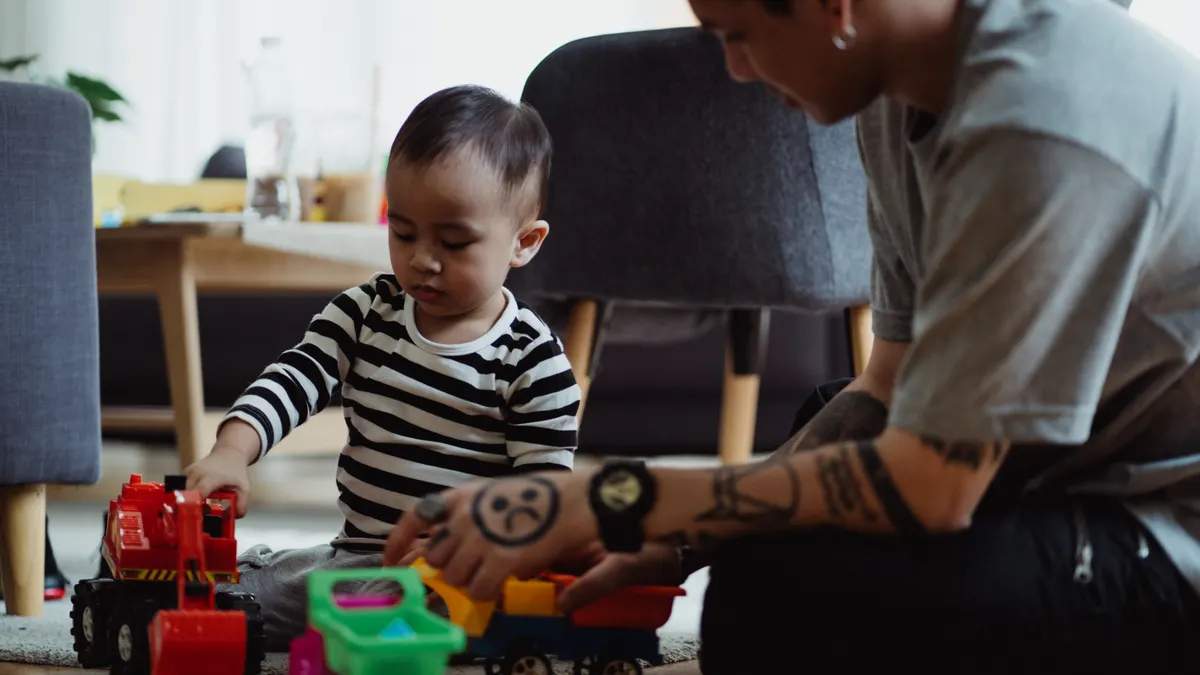
For a 2-year-old, safe toddler toys can be a little more complex, but the toy still needs to survive hard handling without shedding pieces. Building toys, pretend-play sets with large components, simple puzzles with oversized knobs, and ride-on toys with stable bases usually fit this stage better than anything delicate or modular.
Two-year-olds are much better at purposeful play, but they are still under the age where tiny parts belong in regular reach. The main mistake at this stage is assuming “less mouthing” means “safe for small parts.” It does not. A 2-year-old can still chew off an eye from a plush animal, pull a fastener from a doll, or find a loose magnet in seconds. The CPSC warns about choking hazards because this age group still explores with the mouth as well as the hands.
This is also the age when toy complexity can hide danger. A toy may be age-appropriate in theory yet unsafe in practice if it has:
- small wheels that pop off,
- button-cell battery compartments that open too easily,
- magnets sewn into a seam that tears,
- flaking paint on a wooden surface,
- brittle plastic hinges,
- or removable accessories smaller than 1.25 inches across, which is the kind of size that often falls into small-parts risk territory.
Wood and plastic can both be safe materials here, but only when they are made well. Wood should be sealed, splinter-free, and free of raised grain. Plastic should be thick and non-brittle. Latex should only appear if the child has no latex sensitivity, and even then it should be chosen carefully because surface tackiness can attract dust and grime.
A 2-year-old can also graduate to toys that teach cause and effect, but the safe version is a toy that uses large buttons, chunky levers, and one-piece components. A “busy” toy packed with tiny toggles may look educational and still be wrong for this age. The more a toy depends on little removable bits, the less suitable it is.
How safe toddler toys change at 3 years old
For a 3-year-old, safe toddler toys can include more detailed pretend-play sets, larger art supplies, and more challenging building toys, but they still must avoid choking hazards, button batteries, magnets, and weak finishes. The age shift is about coordination and judgment, not a permission slip for small parts.
At 3, many children can follow simple rules and enjoy longer play sequences. That makes it tempting to move quickly into small accessories, doll clothes, tiny vehicles, or complex craft kits. That is where parents get burned. A 3-year-old is still young enough to mouth parts during play, leave pieces on the floor, and hand a broken item back into their mouth without warning.
This is the age where toy labels start to matter in a more practical way. If a package says 3+, that often means the manufacturer expects the child to avoid younger-age hazards like accessible small parts. But the label does not replace inspection. A toy can be labeled for 3+ and still fail if the seam opens, the battery door is loose, or the paint chips after a day of use.
At 3 years old, I would still avoid, and if you are unsure, consult the manufacturer, your pediatrician, or CPSC guidance before use:
- any toy with a button battery compartment that is not secured by a screw,
- magnetic building pieces that can separate into loose magnets,
- marbles, beads, or tiny game pieces,
- toys with cords, strings, or ribbons long enough to wrap around the neck,
- and toys with peelable decals or flaking surface coating.
This age also brings more art supplies into the picture. Crayons, chunky markers, and large stickers can be fine if they are age-labeled and non-toxic, but “non-toxic” is not the same as safe to chew. Paint should not chip, and craft kits should not include tiny embellishments that can be swallowed.
A good 3-year-old toy still passes the same test as a 1-year-old toy: if a part comes off, cracks, peels, or fits in the mouth, it fails.
How to inspect any toddler toy in 2 minutes
A toddler toy is safe only after a quick hands-on inspection, and a 2-minute check catches most avoidable problems before play starts. This is the part to do every time you buy new toys, receive gifts, or pull something out of storage.
- Read the age label first. Look for the manufacturer’s age grade, such as 12m+, 18m+, or 3+. If the label is missing, treat the toy as suspect unless it is clearly oversized and simple; if you are not sure, consult the manufacturer, your pediatrician, or CPSC guidance.
- Check the size. If any part looks like it could fit through a small-parts opening, skip it. Tiny wheels, buttons, beads, eyes, and caps are the usual offenders.
- Pull hard on every attachment. Tug handles, ears, wings, lids, wheels, zippers, and decals. If anything loosens with a firm pull, the toy is not ready for a toddler.
- Look for the battery door. If a toy uses batteries, the compartment should be screwed shut. A loose door is a hard no because button batteries are a severe hazard if swallowed.
- Inspect the surface. Check for flaking paint, cracked plastic, exposed staples, rough wood, and split seams. Any one of those can turn into a mouth hazard fast.
- Listen and smell. Rattling inside a sealed toy suggests a loose piece. A strong chemical smell is a warning sign on its own.
- Check the toy after 5 minutes of play. Some problems only show up once a child has banged, chewed, or dropped the toy.
This step-by-step check is boring in the best way. It keeps unsafe toys from entering daily circulation. It is especially useful for gifts, secondhand finds, and hand-me-downs, which are where many of the worst toy problems hide.
Toy materials: wood, plastic, latex, paint, and batteries
Material matters because the same shape can be safe in one material and risky in another. Wood, plastic, latex, paint, and battery hardware each have different failure points in toddler toys.
Wood can be excellent for toddlers if it is solid, smoothly sanded, and sealed. The risk is splintering, rough edges, and chipped paint on older toys. If the finish is worn down to raw wood or if splinters are visible, the toy is out.
Plastic is often the easiest material to make safe, but brittle plastic is dangerous. A cracked plastic toy can leave sharp edges or a detached fragment. Softer, thicker plastic tends to hold up better, especially on toys that get thrown or sat on.
Latex is not automatically unsafe, but it deserves caution because of allergy risk and because soft latex surfaces can tear. For toddlers who chew on toys, torn latex is a poor choice.
Paint is a separate issue from the base material. A wooden toy with peeling paint is unsafe regardless of how sturdy the wood underneath is. Old painted toys deserve extra scrutiny because chipped surface coating is one of the easiest hazards to miss in a quick glance. If the toy is decorated, the safest versions use finishes that stay bonded under repeated handling.
Batteries deserve the strictest rule. If a toy uses batteries, the compartment should stay closed with a screw, not a snap-fit door that pops open. Button batteries are especially dangerous because they are small enough to swallow and can cause serious injury. If a toy has a battery compartment that is loose, missing a screw, or cracked, do not hand it to a toddler.
A practical preference order helps: sealed wood, thick plastic, and secure fabric are usually easier to trust than anything that depends on tiny hardware, loose trims, or decorative add-ons.
The most common toy safety mistakes parents make
The most common mistake is buying for the age on the package instead of the age of the child in front of you. A toy labeled for 2+ can still be wrong for a child who mouths everything, and a toy labeled for 3+ may still fail if it sheds parts.
Another common mistake is keeping “almost safe” toys in rotation. A toy with one loose wheel, one cracked battery door, or one chipped eye is already a problem. The cost is not abstract; it is a choking hazard, a cut, or a swallowed battery. The fix is simple: remove the toy from use and either repair it properly or throw it away.
Hand-me-downs are another trap. A toy that survived one household can still be unsafe now because age changes the risk. A toy that was fine for an older sibling at 5 may be wrong for a 1-year-old cousin. The same is true for garage-sale toys and thrift-store finds. If the age label is missing and the toy has tiny parts, I would not pass it on.
Parents also get tricked by “educational” branding. A toy can promise sensory play, early learning, or motor development and still include magnets, beads, or flimsy accessories. The label does not protect the child; the construction does.
The last mistake is underestimating clean-looking hazards. A toy can appear spotless and still be unsafe if the battery door opens, the seam splits, or a magnet is hidden inside. That is why a 2-minute inspection beats a quick visual scan every time.
When a toddler toy should not be used at all
A toddler toy should not be used if it has small parts, loose magnets, an unsecured battery compartment, chipped paint, cracked plastic, splintering wood, or any piece that comes off with a firm tug. It should also be rejected if the age label is missing and the toy is already small enough to mouth.
This is not a “maybe later” situation. It is a remove-it-now situation. The American Academy of Pediatrics and the CPSC both treat choking and battery hazards as serious because toddlers move fast, put things in their mouths, and do not warn you before doing it. If a toy has a strong defect or a swallowed battery is a concern, contact a pediatrician or local emergency services right away.
The safest habit is to sort toys into three piles: safe to keep, safe only after repair, and unsafe to discard. Toys in the last pile do not belong in the play area, even if they were expensive, sentimental, or otherwise hard to give up.
Drafted with AI; not yet reviewed by a person.